The VOR
The VOR (VHF Omnidirectional Range) is an aviation navigation instrument utilizing radio frequencies between 108 and 118 MHz. A ground station, located at an airport or along an air route, transmits radio waves that are received by the VOR receiver in the aircraft.
Instrument Description
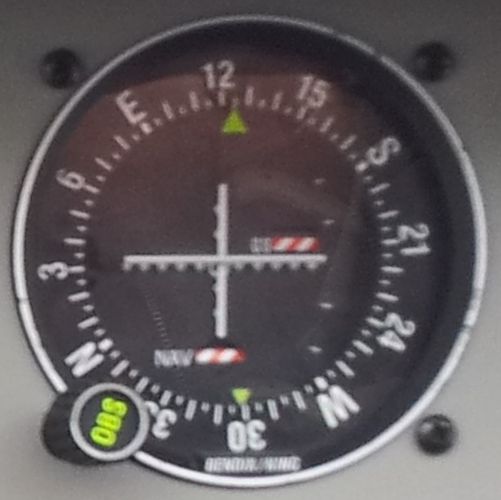
A radial (an angle relative to the ground station) is selected by positioning it above the needle, in this case 125°. The vertical needle (CDI - Course Deviation Indicator) then indicates the selected radial. Small white dots indicate deviations from the radial, representing two degrees each. The “TO” and “FROM” indications show whether the aircraft is flying towards or away from the station, respectively. The 000° (or 360°) radial of the ground-based VOR station always aligns with magnetic north.
The VOR serves two purposes:
- Following radials.
- Defining points or areas, a technique known as “flanking.”
Radial Tracking
To follow a radial, simply observe which direction the needle is deviating. If the needle is to the right, adjust your heading to the right to regain the radial. If the needle is to the left, adjust your heading to the left.
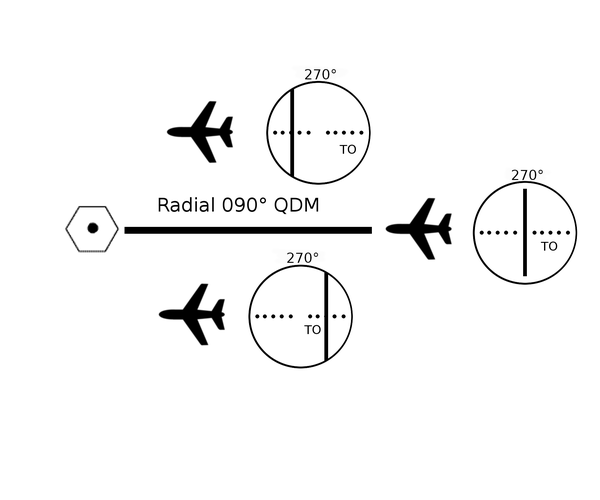
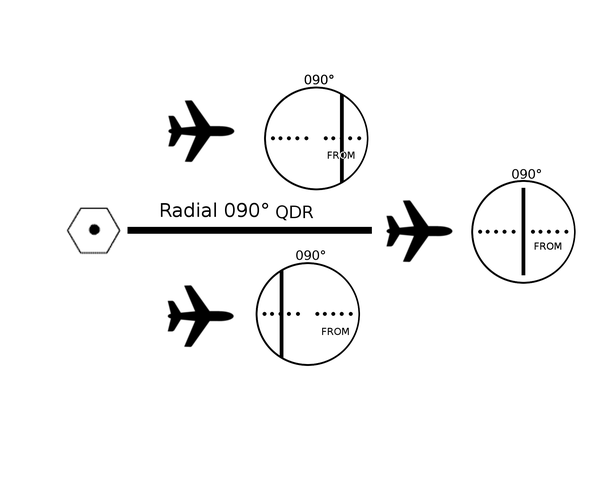
Flanking
Flanking is used to better visualize turning points or airspaces.
For example, if a turning point is located at 090° relative to the station, select the 090° radial on your VOR. As long as the needle is on the side of the station, you have not yet reached the turning point. When the needle is centered, you are directly over the point. And when the needle is opposite the station, you have passed it.
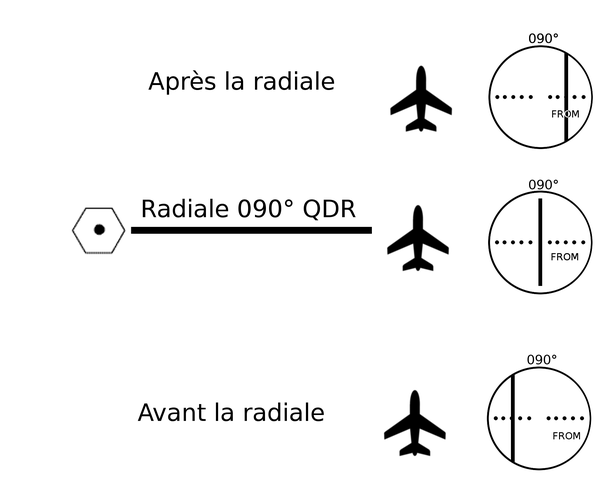
If the aircraft is also equipped with a second VOR, it’s easy to precisely identify your turning point. Both needles will be centered when directly over the chosen point.
The VOR is an excellent instrument that reduces the workload for the pilot (provided you know how to use it!).
To practice, the following websites offer online simulators: